“We receive more direct feedback on young people’s needs, can better structure our offerings accordingly, and ultimately achieve greater impact — concretely: OEBs help us on our path toward equal opportunities.
– START-Foundation
How can learning progress be made visible when learning does not take place in traditional courses with fixed qualifications? How can young people recognize what they have learned — and use these competencies for their further educational and career paths? These are exactly the questions the START Foundation is addressing.
START supports young people with a migration background throughout their educational journeys. Its goal is to promote equal opportunities and foster long-term development of potential. Digital learning opportunities play a central role in this approach, covering topics such as personal development, strengthening democracy, civic engagement, media literacy, and academic subjects. These offerings are provided via the START Campus and are easily accessible to young people across the entire community. Since the 2025/26 school year, START has been using Open Educational Badges (OEB) to support this work.
Making Learning Visible — for Young People and Organizations
The idea behind OEB immediately resonated with START. Badges that can be collected in a digital wallet align perfectly with a youth-centered approach focused on orientation, motivation, and self-efficacy. Visible learning progress provides young people with guidance in an often complex and confusing educational and orientation landscape. For learners, badges primarily mean transparency. They can see what they have already achieved, how individual activities connect, and which areas they can intentionally develop further. The digital approach reflects their everyday reality and has a playful, motivating effect, without compromising the serious and transparent documentation of competencies. Tatjana Kasper describes this added value as follows:
“For young people, it is exciting to receive a certificate they can use for their career paths. For START, it also provides insights into how often different offerings are used and whether the use of badges can increase attractiveness and participation.
In this way, Open Educational Badges create impact on two levels: they strengthen young people’s orientation and motivation while providing START with direct feedback on their needs. On this basis, offerings can be more deliberately structured and further developed — with the overarching goal of increasing impact and systematically advancing equal opportunities.
Badges in Practice: START Coding and START Career
To gain initial experience, START launched a pilot phase using badges in two intensive programs.
In START Coding, participation badges are awarded for the digital IT core program, while competency badges recognize skills acquired in online and in-person coding camps. The formats are supported by qualified mentors from START and the partner organization CodeDoor e.V. Participants who complete the defined minimum number of formats and collect the corresponding badges receive the micro-degree “START Coding” at the end.
A micro-degree thus serves as the certificate concluding a learning pathway. In the case of START Coding, this pathway covers the development of programming skills through to building an individual app. Looking ahead, START is also exploring the option of certifying the mentor training itself with badges, making quality management explicit and transparent as well.

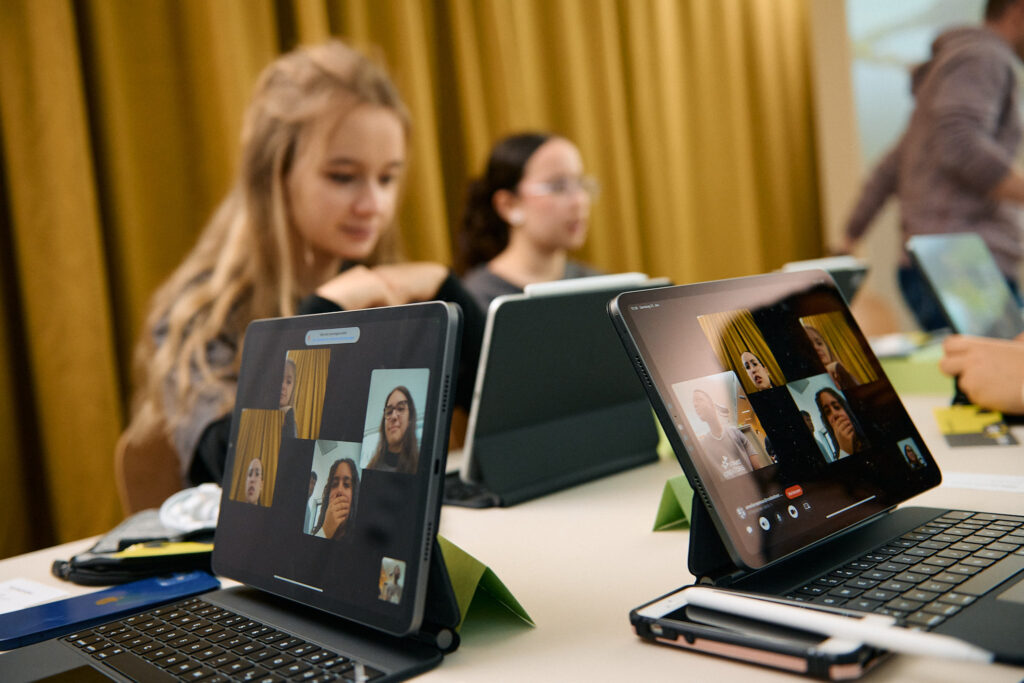
Caption: Young people at START Coding, photo credit: START_André Groth.
In the START Career program, the focus is on career orientation and future skills — from reflecting on personal strengths and weaknesses to gaining insights into different fields of knowledge. Competency badges are awarded for digital workshops and hands-on formats, for example in collaboration with companies, while participation badges recognize attendance at conferences or lectures. Young people receive a micro-degree after completing four digital sessions and one in-person event.
Both programs exemplify how OEB can be used to map structured learning pathways without losing the flexibility required for diverse formats and individual learning journeys.
Making Impact Visible Along the START Impact Logic
At START, badges are not only a form of recognition for learners but also a valuable tool for organizational steering and reflection. Katharina Bürkin highlights the added value of OEB as follows:
“We assign the competencies we aim to strengthen among young people to our impact dimensions, which gives us a clearer picture of where we are having the strongest impact — and where there is still potential.”
From spring 2026 onward, this impact perspective will be further supported by OEB. The OEB dashboard currently under development automatically visualizes the data generated through badges. Organizations will be able to see at a glance how badge issuance, competency areas, and programs evolve over time. An export function is also planned, allowing the data to be used for internal analyses, impact reports, or communication with funders and partner organizations. This makes it possible not only to describe impact qualitatively, but to analyze it in a data-driven way and deliberately further develop learning offerings.
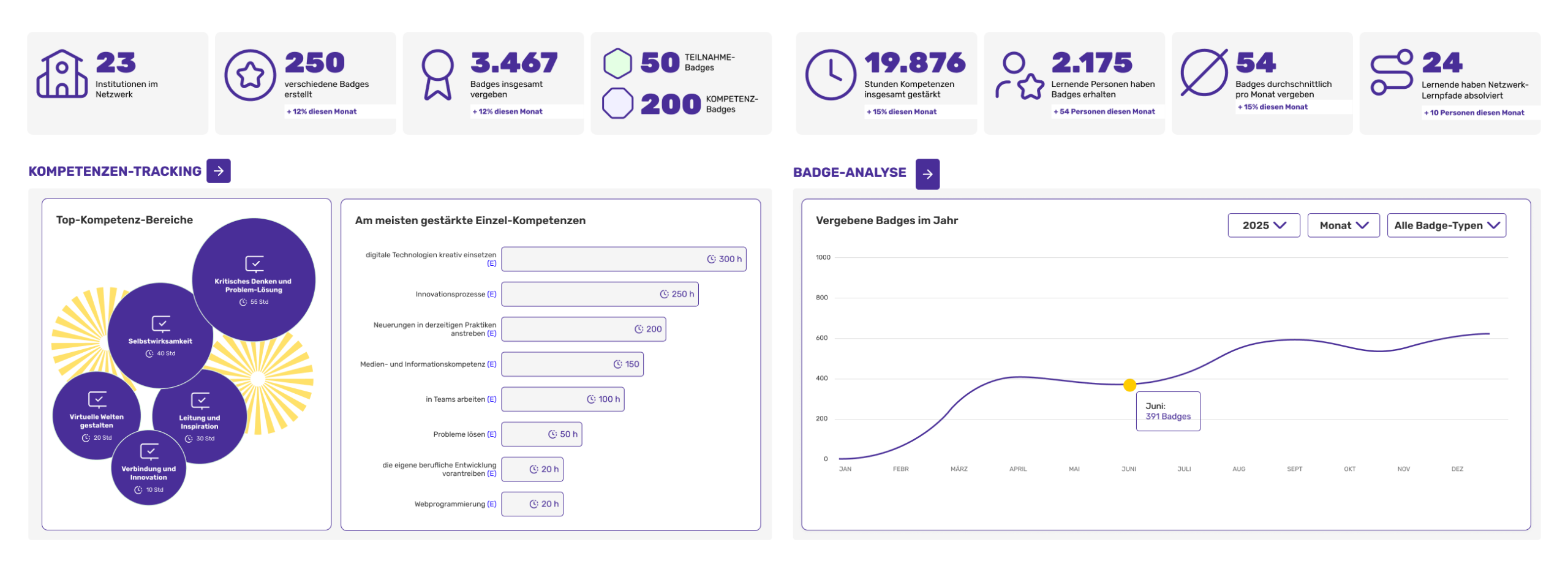
Caption: Example excerpt from an OEB dashboard.
In a next step, it will be possible to link badge data with individual competency frameworks — at START, for example, with its own impact dimensions. These can be stored in the system so that the institution’s OEB dashboard shows not only the strengthened ESCO competency areas, but also how strongly each impact dimension is actually reinforced by the badges awarded.
The OEB Platform in Practice
At START, the starting point for badge creation is course descriptions that are already produced for course communication. Building on this, the team works closely with course leaders and mentors to clarify which competencies are being taught. For competency alignment, START uses both the AI assistant on OEB and its own research within the ESCO framework. The AI assistant serves as a structuring support, complementing the team’s professional assessment with additional suggestions. Because many event descriptions are intentionally short and low-threshold, it is especially important to assess these suggestions critically and prioritize them in line with the organization’s own impact logic. The selected competencies then become an integral part of the badge.
Badges are awarded either directly via email to participants or, in the case of in-person formats, via QR codes that allow learners to claim the badge themselves.
Positive Response — and Early Signals of Impact
Interest in badges is evident at START on multiple levels. It is most clearly visible among the young people themselves: many participants — in the case of START Coding, all of them — have claimed and downloaded their badges. They value the opportunity to use badges in their CVs and see them as a potential advantage in the application process. Even though it is still early, START is already observing rising participation numbers in certain areas and aims to further investigate the role that the introduction of badges may be playing. In addition, young people are actively requesting badges for further digital offerings, indicating that badges are perceived as attractive and relevant.
Within START, Open Educational Badges are prompting a more in-depth engagement with competency goals. At the same time, interest is growing among partner organizations in the education sector and among companies that are closely observing the potential of standardized, digital competency credentials.
Learning from Practice: What START Shares
For a next rollout, START would above all do one thing differently: involve more colleagues earlier and clearly document the badge process internally. It is also helpful to agree on a small set of core competencies at the outset — “so you don’t get lost in the ESCO jungle” and can move into action more quickly. With some lead time, processes can be further standardized and automated, for example by prioritizing QR code issuance directly after events.
START also recommends making use of the personal support provided by the OEB team, the FAQs and video tutorials on the OEB website, as well as the available badge templates as a graphical foundation. The most important tip is simple: just get started. “Participants benefit, feel motivated, and their learning progress becomes visible and transferable.”
→ In the long term, START plans to expand the use of badges across all offerings and to consistently design learning pathways in line with its own impact dimensions. This will enable young people to see more clearly which competency areas they are developing in — and which pathways best support their progress.
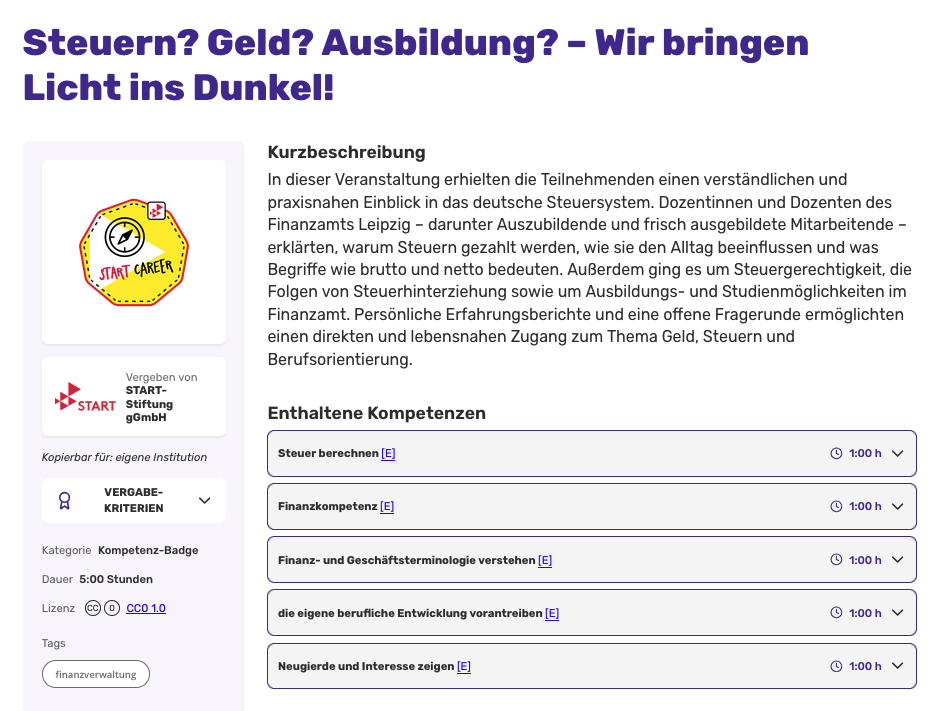
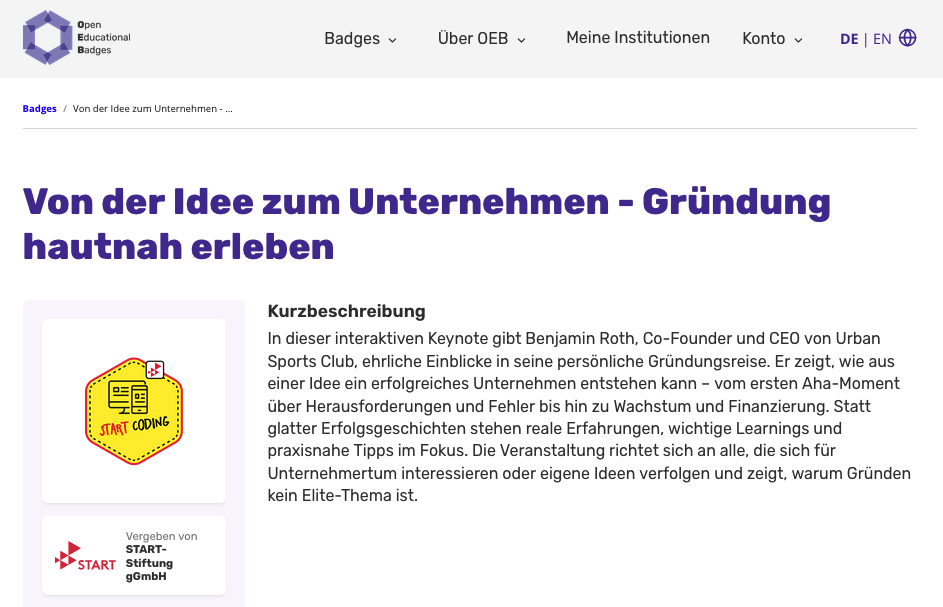
Caption: START badges.
*OEB works with a standardized competency framework: the ESCO standard. ESCO is the EU’s competency taxonomy and includes around 14,000 skills in 28 languages. This ensures that all badges speak the same language, are comparable, and remain interoperable — regardless of where they were earned.
CURIOUS TO LEARN MORE?
Try it yourself for free.
Register yourself and your institution and create your first badge in just a few minutes.