“We want to issue badges where exams actually take place – directly from our own system. The OEB API makes this possible.”
– Oliver Stroh, DLGI
Digital skills are indispensable today – in schools, vocational training, professional life, and everyday contexts. With the international ICDL certification (“computer driving licence”), a globally recognised standard has existed for many years that assesses and makes these skills visible. In Germany, the certification is administered by the Dienstleistungsgesellschaft für Informatik (DLGI). As a pioneer in digital education, the DLGI actively shapes and continuously develops the educational landscape. This raised a key question for the organisation: how can qualifications be documented in a contemporary way? The team found the answer in Open Educational Badges (OEB).
“OEB offers a smart, flexible, and intuitive way to create and issue individual badges,” says Oliver Stroh, who oversaw the implementation. What mattered was not only the quality of the badges themselves, but also the technical integration options. Badge issuance needed to work seamlessly within the existing ICDL customer portal – something made possible by the open interface of the OEB platform.
Digital skills – data-driven, verifiable, shareable
ICDL pursues a clear goal: digital qualifications should be clearly evidenced, verifiable, and immediately usable. Badges serve students, trainees, and professionals as digital proof of passed exams in areas such as office applications, data processing, IT security, or online communication. Two types of badges are used: competence badges for individual exams and micro-degrees for certificates that bundle several modules. The underlying competencies are based on the international ICDL standard, which is closely aligned with DIGCOMP* and thus with the European ESCO** skills framework that underpins badges on OEB. The result is digital credentials that are understandable, interoperable, and flexible across Europe.
The technological core: issuing badges directly from the organisation’s own system
The decisive step was the direct connection of the ICDL customer portal to the open OEB API – an interface that allows both systems to communicate securely. This means badges are issued exactly where exams are managed: within the DLGI’s own portal, without any manual intermediate steps. After passing an exam, learners see a “Request badge” button. One click is enough: the portal authenticates with OEB via client ID and secret, receives an OAuth token, and automatically sends the appropriate badge by email. “The badge reaches learners without detours and makes their competence acquisition visible immediately,” says Oliver Stroh. For the DLGI, this architecture means maximum efficiency and a consistently streamlined process. For learners, it means instant, verifiable, and shareable credentials – ideal for job applications, online profiles, or career platforms such as LinkedIn. Digitally savvy users actively integrate their badges into their portfolios, while demand in schools continues to grow as the benefits become clearer.
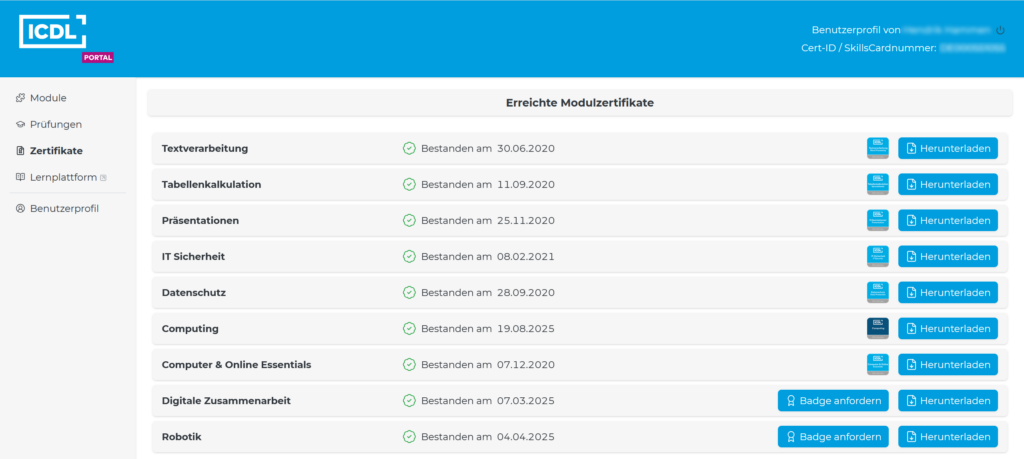
Caption: The “Request badge” button in the ICDL portal.
ICDL badges: standards, AI assistance, and custom competencies
When creating badges, the team combines standardization with its own domain expertise. The OEB AI assistant serves as a starting point by suggesting suitable ESCO competencies for each learning unit. These suggestions are then refined thematically or supplemented via the search function. The visual design of the badges is created by external graphic designers. In some cases, suitable competencies cannot be found in ESCO—for example, for certifications that DLGI develops for external partners. In those situations, the team defines its own competency descriptions directly within OEB to accurately reflect the specific requirements.
At first, it felt unfamiliar to DLGI that OEB represents competency acquisition in terms of time. Since DLGI does not deliver courses itself but provides learning materials and administers exams, specifying hours initially seemed difficult to assess. On closer examination, however, it became clear that ICDL already provides partners with guideline estimates for the duration of each module. These can be meaningfully broken down to the level of individual competencies, creating a consistent point of reference. Today, the team clearly sees the added value: time-based information makes badges more precise and offers helpful transparency for both learners and partner institutions.
Looking ahead, DLGI would welcome even more flexibility when creating badges—for example, the ability to organize selected competencies by category using drag-and-drop directly within the badge editor.
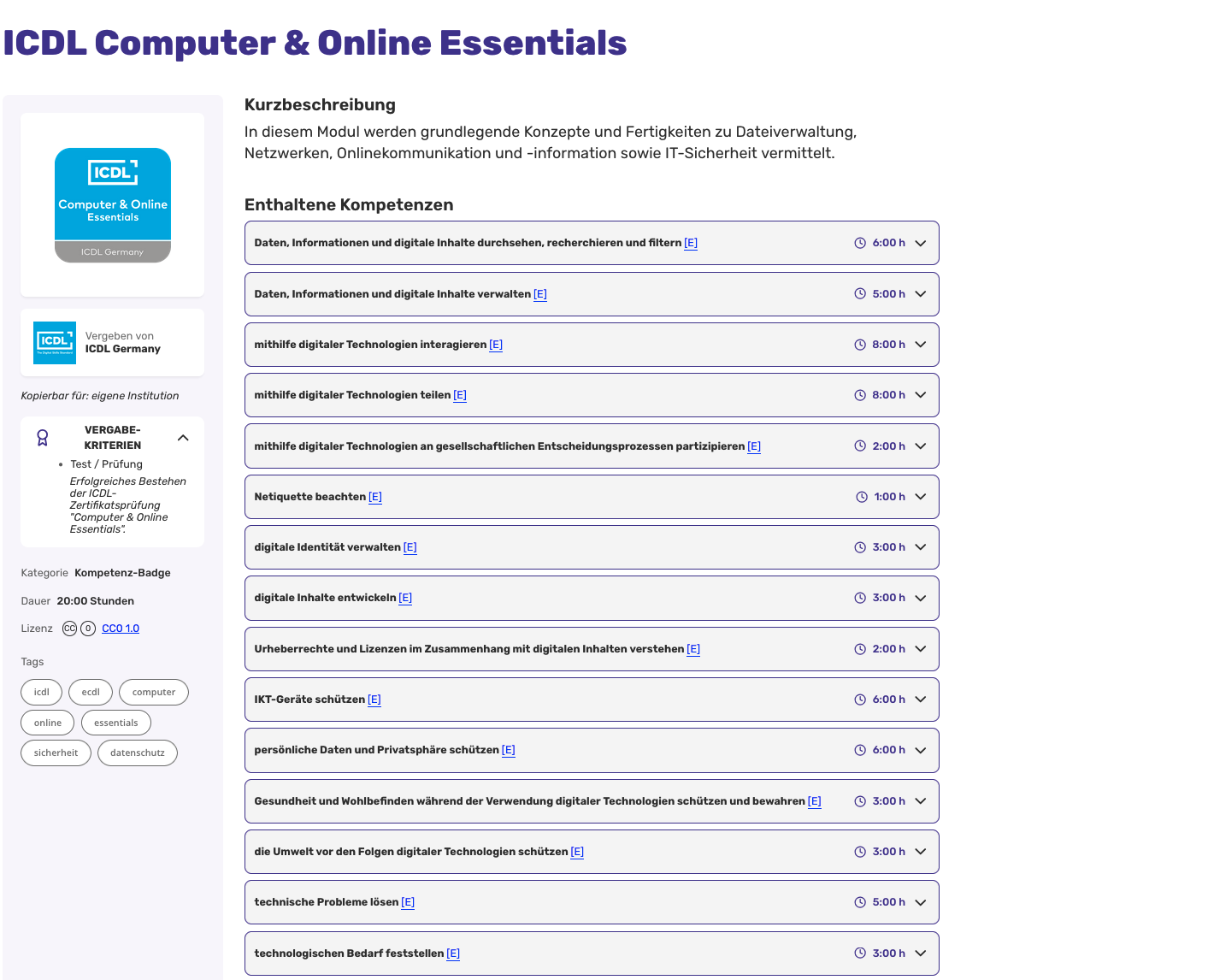
Caption: ICDL badge with ESCO competencies.
Insights from practice
Digitally verifiable credentials make it much easier for learners to present their qualifications in professional contexts. They combine established standards with modern verification and are available exactly where they are needed. By connecting directly to the OEB API, DLGI has made the badge issuance process so efficient that no manual steps are required anymore — everything runs automatically, securely, and reliably in the background. The result is a system that does more than simply confirm exam results: it makes competence development visible while delivering a smooth and consistent user experience. The OEB API is particularly well suited for organizations that issue large volumes of badges or want to integrate certification seamlessly into existing platforms. In the meantime, badge creation and editing can also be handled via the API directly from an organization’s own system, and learners’ badge backpacks and competence profiles can be displayed within the same environment.
DLGI has also observed that partner organizations and customers quickly recognize the added value. According to Stroh, many respond very positively to the option of having badges created for their learning units. DLGI therefore offers this proactively as an extended service that further strengthens its certifications.
The future of digital certification
For DLGI, one thing is clear: badges are a central building block for the future of certification. They connect formal credentials with modern, competence-oriented documentation and give learners new ways to make their skills visible — far beyond traditional paper or PDF certificates. At the same time, the integration via the OEB API demonstrates how easily digital badge issuance can be embedded into existing systems. Oliver Stroh looks ahead with confidence: “We’re excited to see badges gaining wider adoption, to the point where learners naturally expect to receive a badge when they complete a qualification.” Until then, DLGI continues to lead the way — convinced that digital credentials will play a decisive role in shaping modern qualification pathways.
🔗 Technical Documentation Introduction
🔗 Detailed Endpoint-Documentation
Curious?
Give it a try!
Register for free and create your first badge in just a few minutes.
*Open Educational Resources are free learning and teaching materials that are published under an open license and thus made available for reuse by anyone interested.
**OEB is based on a standardized framework, the ESCO competence standard. ESCO is the EU’s skills taxonomy and includes 14,000 skills in 28 languages. This ensures that all our badges speak the same language, remain comparable, and integrate seamlessly — no matter where they were earned.
*** ESD is the abbreviation for Education for Sustainable Development. It refers to education that enables people to think and act in a sustainable manner. It enables each individual to understand the impact of their own actions on the world.