At the Independent Institute for Environmental Issues (UfU), everything revolves around future skills — and how to teach them effectively. In the NaKlima! training program, teachers discover creative ways to integrate nature-based climate protection into their lessons, for example through the digital learning journeys on klimacampus.org. To make the resulting competencies visible, UfU uses digital certificates via Open Educational Badges (OEB).
“We found the idea exciting — not just issuing a plain certificate, but using OEB to align with the European Skills, Competences, Qualifications and Occupations framework, ESCO*,” explains Swenja Rosenwinkel, project lead at UfU. “It’s modern and a great way to build on existing standards.”
ESCO makes skills comparable and recognizable across Europe — an important step toward a transparent, future-oriented approach to documenting education.
Teaching climate protection and making skills visible
NaKlima! is a modular training program with several components. Teachers don’t just gain subject knowledge; they also design their own lesson plans around nature-based climate protection. After completing the course, they receive a digital badge via OEB — a visible mark of their engagement and acquired skills.
“We also want to show teachers that these digital credentials exist,” Swenja says. “Many have never heard of badges, but immediately see the potential for their students, especially for career orientation.”
She’s referring to OEB’s learner functions: participants can collect badges in a personal backpack, get a visual overview of their skill profiles, and share their badges — for instance on social media or in job applications.
Educational institutions also benefit from OEB’s features: badge records make it possible to track which competencies students have strengthened and which professional trainings teachers have completed. This creates a valuable foundation for developing staff qualifications in a targeted way. In the future, a dashboard view will make this even clearer.
Modular learning, digital recognition
UfU uses competence-based badges awarded at the end of the training program. While each of the three modules could theoretically be recognized separately, the team decided to issue a badge only for completing the full program.
“If participants receive a certificate after just one module, their motivation to continue sometimes drops,” Swenja notes. “But a micro-degree can be a nice incentive — for example, if someone has to take a break, it works like a little ‘keep going!’ signal.”
Badges are issued either directly by email or via a learner request using a QR code — depending on what works best organizationally. The flexibility of the OEB platform is a clear advantage for the team.
From manual work to AI-assisted routine
To create badges, UfU uses the AI assistant built into OEB, which links learning content with relevant competencies from the ESCO standard. “At first, it didn’t go completely smoothly,” Swenja recalls. “The AI sometimes made suggestions that didn’t fit our content, so there was a lot of manual work. If you’ve never worked with ESCO, you first have to find your bearings. But the OEB team supported us throughout.”
With growing experience, the process became more efficient. The AI tool’s keyword search also proved useful for finding better-matched competencies. “And being able to copy and adapt existing badges saves an enormous amount of time,” she adds. “It’s also handy to see at a glance who has already received a certificate.”
Wishes and further development
For the future, Swenja hopes for even more customization options — for example, adding event dates or adjusting the layout of the PDF certificates that are generated alongside the badges and sent to participants. It’s also important that these digital credentials are understandable even outside the platform:
“Many people still want a traditional certificate, because they’re not familiar with digital badges yet. It helps when it’s immediately clear what a badge represents.”
The OEB team is already responding: the current redesign of the PDF certificates clarifies the link between digital and analog recognition. A PDF editor is also planned, allowing institutions to upload custom backgrounds in their own design. Soon, event dates can also be added directly during badge issuance. The AI assistant continues to be improved as well.
Digital recognition with a future
For UfU, OEB has proven to be a practical, professional, and time-efficient tool. “The badges look good and feel official — not like something you made yourself,” Swenja says. She believes “it’s a powerful idea to make learning visible and comparable across Europe. If schools and employers start recognizing badges, this could grow into something really big.”
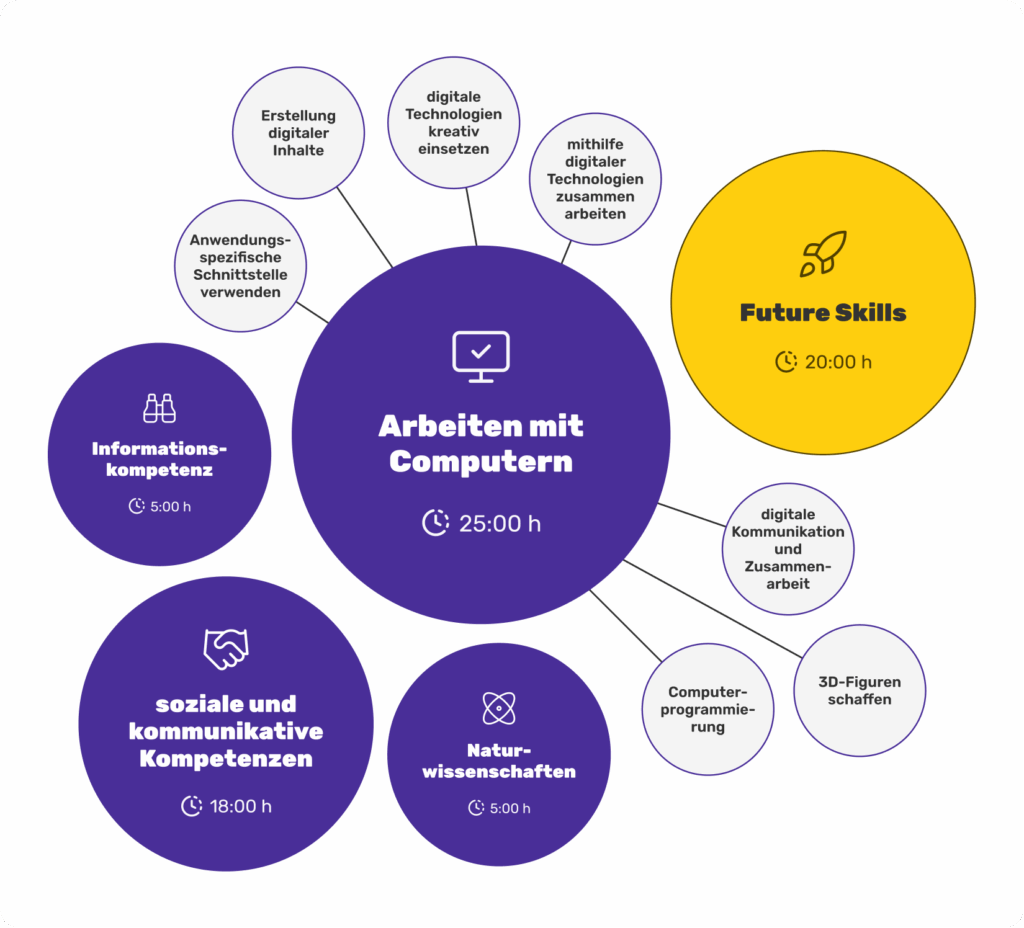
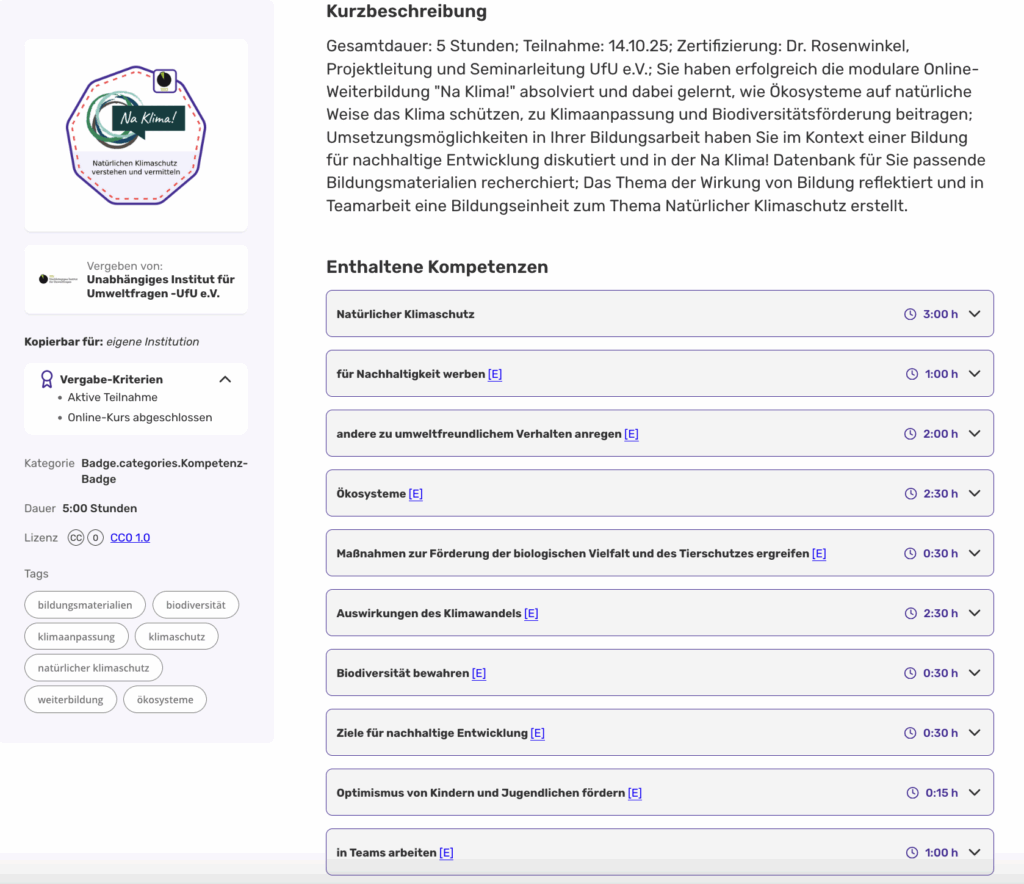
Caption: Visualization of a competence profile (left) / UfU badge with ESCO competencies (right).
Curious?
With OEB, you can easily create digital certificates, make competencies visible, and document learning progress — from schools and extracurricular programs to adult education.
* OEB is based on a standardized framework — the ESCO competence standard. ESCO is the European Union’s skills taxonomy and includes 14,000 skills in 28 languages. This ensures that all our badges “speak the same language,” making them comparable and interoperable, no matter where they were earned.