Category: Article

  • New Year, new ways: OEB in 2026

    New Year, new ways: OEB in 2026

    What we have achieved – and how we will move forward together
    Open Educational Badges (OEB) emerged from the research and development project MINT.OBadges and was funded by the Federal Ministry of Education, Family Affairs, Senior Citizens, Women and Youth (BMBFSFJ) as part of the “Mein Bildungsraum” (My Educational Space) program. The funding period ended at the turn of the year.

    The successful completion of “MINT.OBadges” does not mark an end point, but rather a milestone: OEB will continue and will be further developed from 2026 onwards by the partner organization mycelia gGmbH. matrix gGmbH will focus on further application scenarios for OEB, while openSenseLab gGmbH will support the technical development and test application environments in the NGO and higher education sectors. The partners intend to continue working together on the vision behind OEB in the future.

    Over the past two years, our hypothesis has been confirmed: the idea of ​​making competence acquisition visible – regardless of when, where, or how learning takes place – is a viable one. Open Education Platforms (OEBs) create the opportunity to make competences visible and usable, as well as to make learning opportunities more accessible. What we have built together now forms the foundation for the next steps.

    Our most important milestones
    Much has been accomplished during the project: conceptually, culturally, methodologically, and technologically. OEB has evolved into an infrastructure that makes competence acquisition visible in a wide variety of educational and learning environments. Here’s what we’ve achieved:

    • Development and iterative enhancement of the OEB platform for creating, awarding, and collecting badges
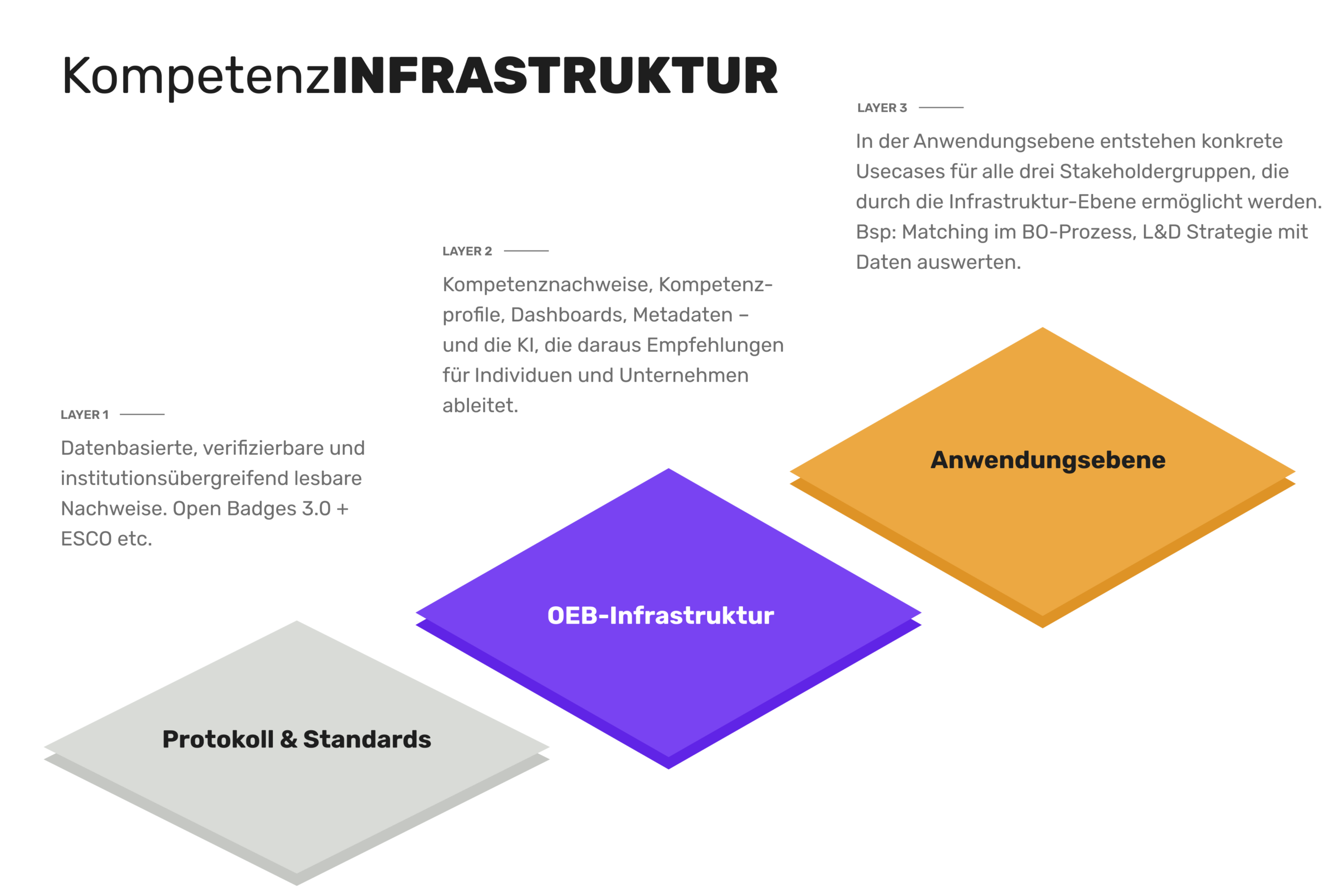
    • Setting up an Open Badge 3.0 server with standards-compliant integration of ESCO as a competency taxonomy
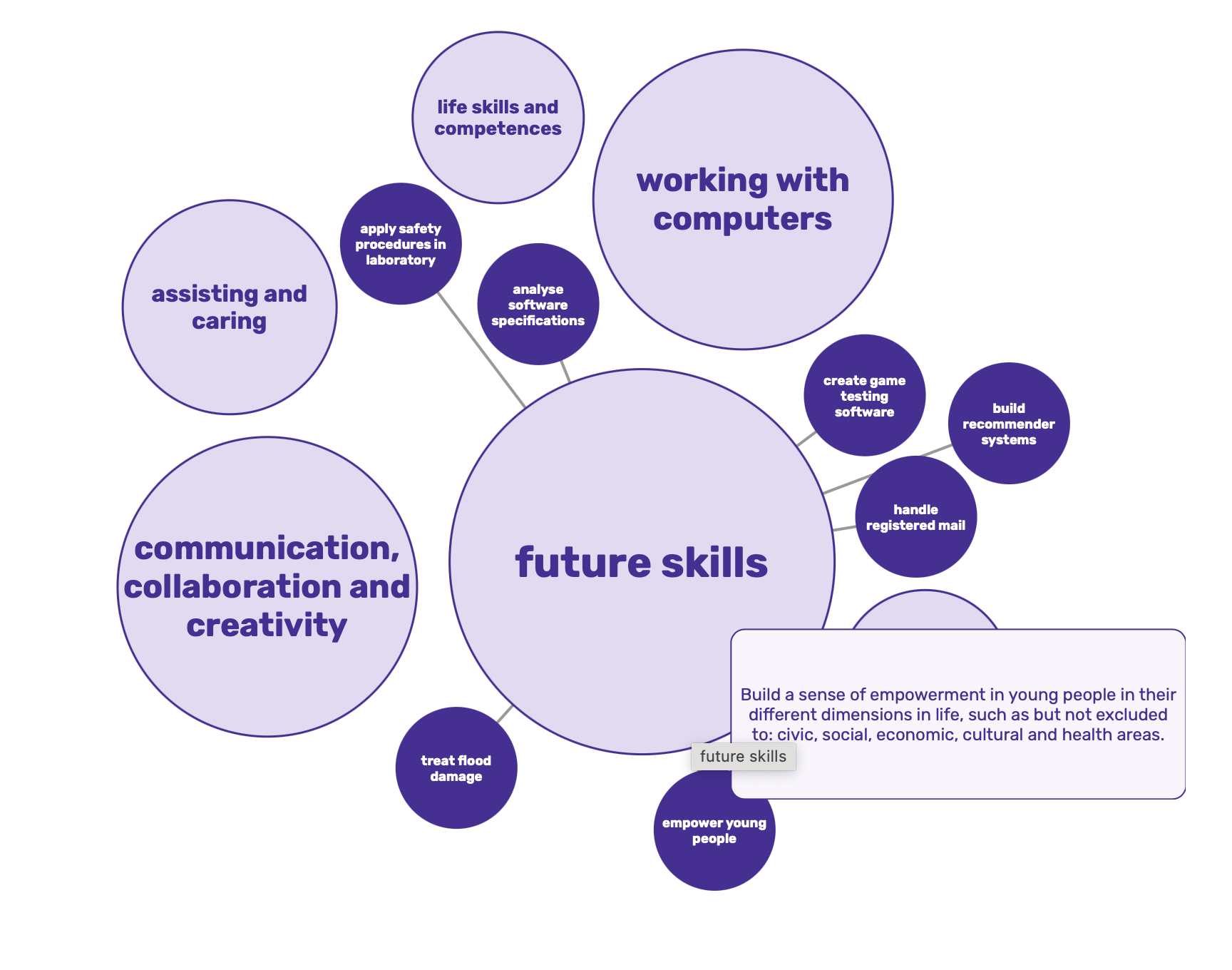
    • Integration of competency frameworks (ESCO, Future Skills)
    • Establishment of a networking function to promote collective impact
    • Integration of three badge types (participation badge, competency badge, and micro degree)
    • Connectable learning pathways across various educational stakeholders
    • Development of a “backpack” function for learners to create relevance (individual competency profile)
    • Badges as a unifying element in real-world laboratories
    • Gaining and transferring scientific knowledge
    • Strengthening the recognition and acceptance of badges
    • Building a committed, open OEB community
    • Intensive dialogue between education, politics, business, and research
    • Greater equality of opportunity through digital, open, and Clear evidence
    • Participation in and presentations at relevant conferences (Forum Education Digitalization, STEM Barcamps, Epic Paris, etc.)

    Thus, OEBs today represent an infrastructure that strengthens recognition, permeability and orientation within the education system.

    All results remain publicly accessible. Feel free to take a look at our OEB magazine and delve into over two years of project work:

    Thank you for over two years of developing together.
    We thank all our network partners, the community, our users, sponsors, partners, and everyone who tries out, questions, designs, and develops badges. This collaborative work is crucial to the impact OEB has.

    Our future begins now.
    Now we look further ahead. The year 2026 marks the start of a new phase in which we will strategically develop OEB further:

    • Development of dashboards for data visualization and impact analysis
    • Custom PDF certificate layout
    • Expansion of ESCO structures
    • Support for (educational) institutions in implementation and use
    • Expansion of application areas
    • Long-term integration of OEB into educational structures
    • Use of the developed open-source platform in other projects

    Together we are creating an open competence ecosystem in which competences are visible, usable and connectable.

    Thinking ahead together
    OEB is just getting started. We warmly invite you to actively shape the future – whether as a user, supporter, or partner.

    You can find all the information and direct contact details here:

  • START: Making Impact Visible with OEB

    START: Making Impact Visible with OEB

    How can learning progress be made visible when learning does not take place in traditional courses with fixed qualifications? How can young people recognize what they have learned — and use these competencies for their further educational and career paths? These are exactly the questions the START Foundation is addressing.
    START supports young people with a migration background throughout their educational journeys. Its goal is to promote equal opportunities and foster long-term development of potential. Digital learning opportunities play a central role in this approach, covering topics such as personal development, strengthening democracy, civic engagement, media literacy, and academic subjects. These offerings are provided via the START Campus and are easily accessible to young people across the entire community. Since the 2025/26 school year, START has been using Open Educational Badges (OEB) to support this work.

    Making Learning Visible — for Young People and Organizations
    The idea behind OEB immediately resonated with START. Badges that can be collected in a digital wallet align perfectly with a youth-centered approach focused on orientation, motivation, and self-efficacy. Visible learning progress provides young people with guidance in an often complex and confusing educational and orientation landscape. For learners, badges primarily mean transparency. They can see what they have already achieved, how individual activities connect, and which areas they can intentionally develop further. The digital approach reflects their everyday reality and has a playful, motivating effect, without compromising the serious and transparent documentation of competencies. Tatjana Kasper describes this added value as follows:

    In this way, Open Educational Badges create impact on two levels: they strengthen young people’s orientation and motivation while providing START with direct feedback on their needs. On this basis, offerings can be more deliberately structured and further developed — with the overarching goal of increasing impact and systematically advancing equal opportunities.

    Badges in Practice: START Coding and START Career
    To gain initial experience, START launched a pilot phase using badges in two intensive programs.
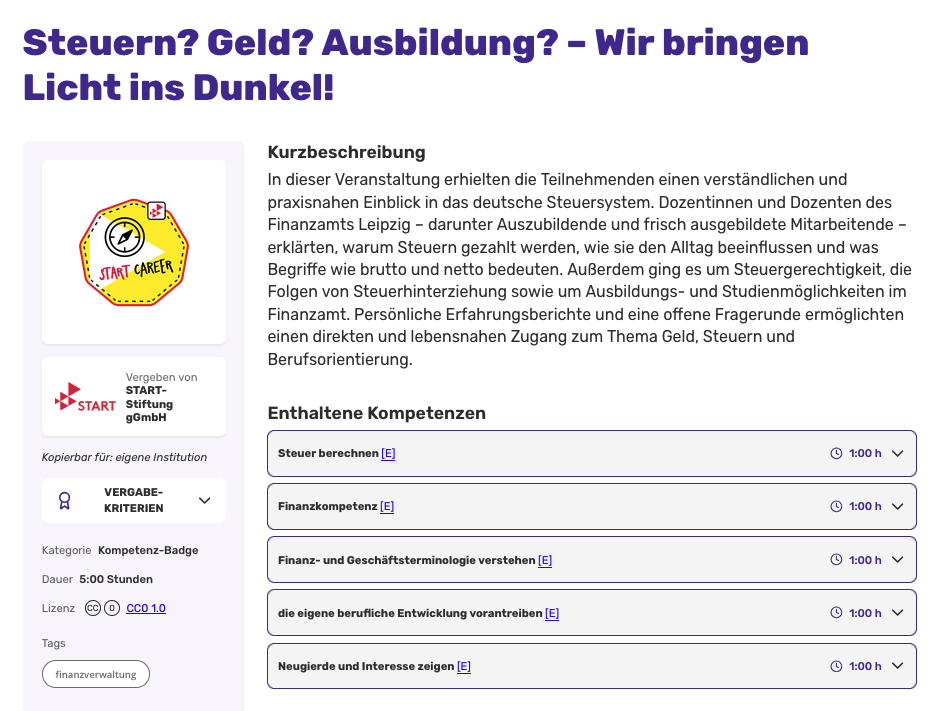
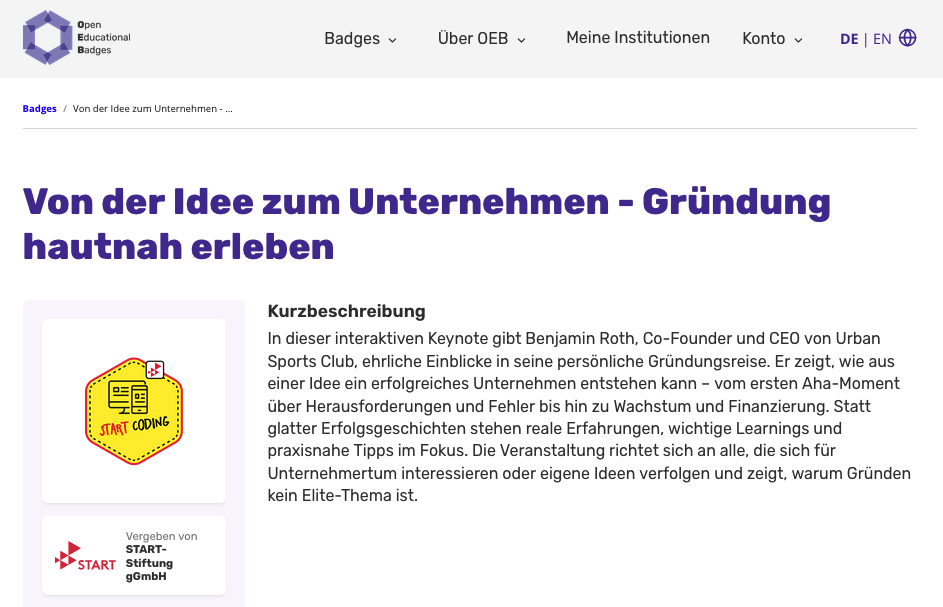
    In START Coding, participation badges are awarded for the digital IT core program, while competency badges recognize skills acquired in online and in-person coding camps. The formats are supported by qualified mentors from START and the partner organization CodeDoor e.V. Participants who complete the defined minimum number of formats and collect the corresponding badges receive the micro-degree “START Coding” at the end.
    A micro-degree thus serves as the certificate concluding a learning pathway. In the case of START Coding, this pathway covers the development of programming skills through to building an individual app. Looking ahead, START is also exploring the option of certifying the mentor training itself with badges, making quality management explicit and transparent as well.

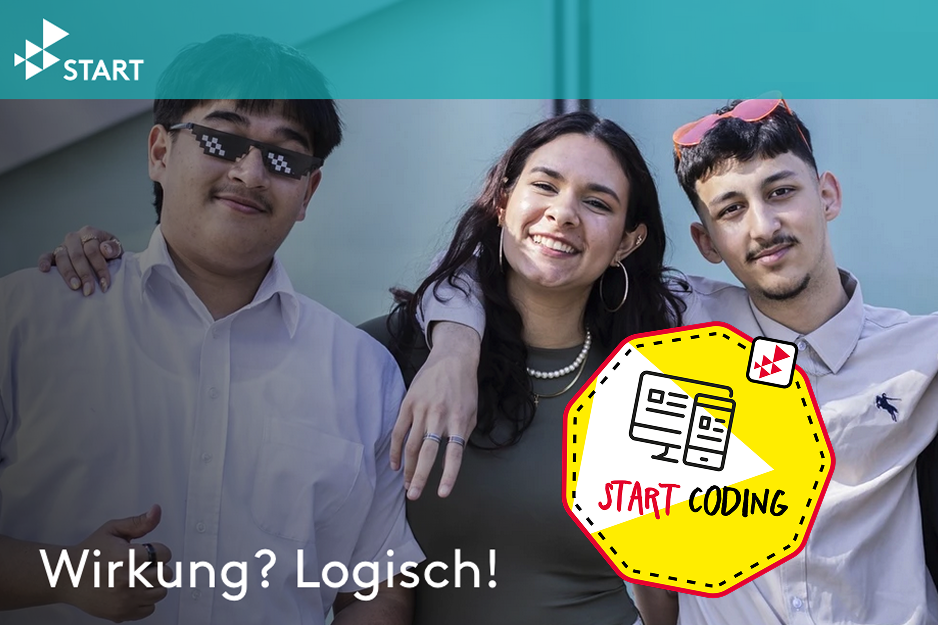
    Caption: Young people at START Coding, photo credit: START_André Groth.

    In the START Career program, the focus is on career orientation and future skills — from reflecting on personal strengths and weaknesses to gaining insights into different fields of knowledge. Competency badges are awarded for digital workshops and hands-on formats, for example in collaboration with companies, while participation badges recognize attendance at conferences or lectures. Young people receive a micro-degree after completing four digital sessions and one in-person event.

    Both programs exemplify how OEB can be used to map structured learning pathways without losing the flexibility required for diverse formats and individual learning journeys.

    Making Impact Visible Along the START Impact Logic
    At START, badges are not only a form of recognition for learners but also a valuable tool for organizational steering and reflection. Katharina Bürkin highlights the added value of OEB as follows:

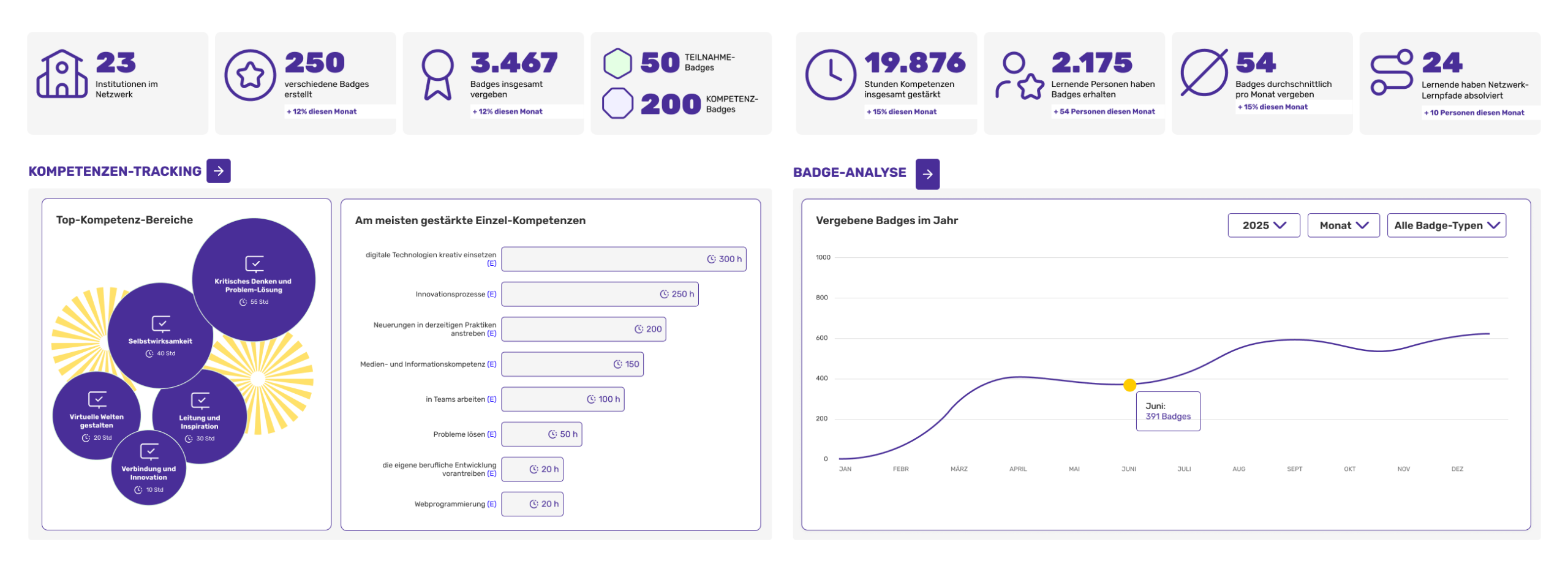
    From spring 2026 onward, this impact perspective will be further supported by OEB. The OEB dashboard currently under development automatically visualizes the data generated through badges. Organizations will be able to see at a glance how badge issuance, competency areas, and programs evolve over time. An export function is also planned, allowing the data to be used for internal analyses, impact reports, or communication with funders and partner organizations. This makes it possible not only to describe impact qualitatively, but to analyze it in a data-driven way and deliberately further develop learning offerings.

    Caption: Example excerpt from an OEB dashboard.

    In a next step, it will be possible to link badge data with individual competency frameworks — at START, for example, with its own impact dimensions. These can be stored in the system so that the institution’s OEB dashboard shows not only the strengthened ESCO competency areas, but also how strongly each impact dimension is actually reinforced by the badges awarded.

    The OEB Platform in Practice
    At START, the starting point for badge creation is course descriptions that are already produced for course communication. Building on this, the team works closely with course leaders and mentors to clarify which competencies are being taught. For competency alignment, START uses both the AI assistant on OEB and its own research within the ESCO framework. The AI assistant serves as a structuring support, complementing the team’s professional assessment with additional suggestions. Because many event descriptions are intentionally short and low-threshold, it is especially important to assess these suggestions critically and prioritize them in line with the organization’s own impact logic. The selected competencies then become an integral part of the badge.
    Badges are awarded either directly via email to participants or, in the case of in-person formats, via QR codes that allow learners to claim the badge themselves.

    Positive Response — and Early Signals of Impact
    Interest in badges is evident at START on multiple levels. It is most clearly visible among the young people themselves: many participants — in the case of START Coding, all of them — have claimed and downloaded their badges. They value the opportunity to use badges in their CVs and see them as a potential advantage in the application process. Even though it is still early, START is already observing rising participation numbers in certain areas and aims to further investigate the role that the introduction of badges may be playing. In addition, young people are actively requesting badges for further digital offerings, indicating that badges are perceived as attractive and relevant.

    Within START, Open Educational Badges are prompting a more in-depth engagement with competency goals. At the same time, interest is growing among partner organizations in the education sector and among companies that are closely observing the potential of standardized, digital competency credentials.

    Learning from Practice: What START Shares
    For a next rollout, START would above all do one thing differently: involve more colleagues earlier and clearly document the badge process internally. It is also helpful to agree on a small set of core competencies at the outset — “so you don’t get lost in the ESCO jungle” and can move into action more quickly. With some lead time, processes can be further standardized and automated, for example by prioritizing QR code issuance directly after events.
    START also recommends making use of the personal support provided by the OEB team, the FAQs and video tutorials on the OEB website, as well as the available badge templates as a graphical foundation. The most important tip is simple: just get started. “Participants benefit, feel motivated, and their learning progress becomes visible and transferable.”
    In the long term, START plans to expand the use of badges across all offerings and to consistently design learning pathways in line with its own impact dimensions. This will enable young people to see more clearly which competency areas they are developing in — and which pathways best support their progress.

    Caption: START badges.

    🔗 OEB-Profil von START


    *OEB works with a standardized competency framework: the ESCO standard. ESCO is the EU’s competency taxonomy and includes around 14,000 skills in 28 languages. This ensures that all badges speak the same language, are comparable, and remain interoperable — regardless of where they were earned.

  • ICDL: Issuing Digital Badges for the Computer Driving Licence via the OEB API

    ICDL: Issuing Digital Badges for the Computer Driving Licence via the OEB API

    “We want to issue badges where exams actually take place – directly from our own system. The OEB API makes this possible.”
    Oliver Stroh, DLGI

    Digital skills are indispensable today – in schools, vocational training, professional life, and everyday contexts. With the international ICDL certification (“computer driving licence”), a globally recognised standard has existed for many years that assesses and makes these skills visible. In Germany, the certification is administered by the Dienstleistungsgesellschaft für Informatik (DLGI). As a pioneer in digital education, the DLGI actively shapes and continuously develops the educational landscape. This raised a key question for the organisation: how can qualifications be documented in a contemporary way? The team found the answer in Open Educational Badges (OEB).

    “OEB offers a smart, flexible, and intuitive way to create and issue individual badges,” says Oliver Stroh, who oversaw the implementation. What mattered was not only the quality of the badges themselves, but also the technical integration options. Badge issuance needed to work seamlessly within the existing ICDL customer portal – something made possible by the open interface of the OEB platform.

    Digital skills – data-driven, verifiable, shareable
    ICDL pursues a clear goal: digital qualifications should be clearly evidenced, verifiable, and immediately usable. Badges serve students, trainees, and professionals as digital proof of passed exams in areas such as office applications, data processing, IT security, or online communication. Two types of badges are used: competence badges for individual exams and micro-degrees for certificates that bundle several modules. The underlying competencies are based on the international ICDL standard, which is closely aligned with DIGCOMP* and thus with the European ESCO** skills framework that underpins badges on OEB. The result is digital credentials that are understandable, interoperable, and flexible across Europe.

    The technological core: issuing badges directly from the organisation’s own system
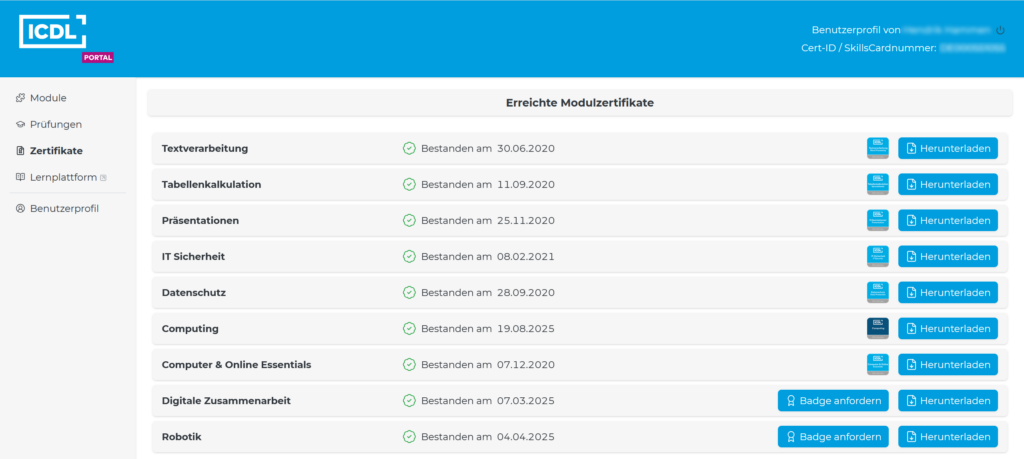
    The decisive step was the direct connection of the ICDL customer portal to the open OEB API – an interface that allows both systems to communicate securely. This means badges are issued exactly where exams are managed: within the DLGI’s own portal, without any manual intermediate steps. After passing an exam, learners see a “Request badge” button. One click is enough: the portal authenticates with OEB via client ID and secret, receives an OAuth token, and automatically sends the appropriate badge by email. “The badge reaches learners without detours and makes their competence acquisition visible immediately,” says Oliver Stroh. For the DLGI, this architecture means maximum efficiency and a consistently streamlined process. For learners, it means instant, verifiable, and shareable credentials – ideal for job applications, online profiles, or career platforms such as LinkedIn. Digitally savvy users actively integrate their badges into their portfolios, while demand in schools continues to grow as the benefits become clearer.

    Caption: The “Request badge” button in the ICDL portal.

    ICDL badges: standards, AI assistance, and custom competencies
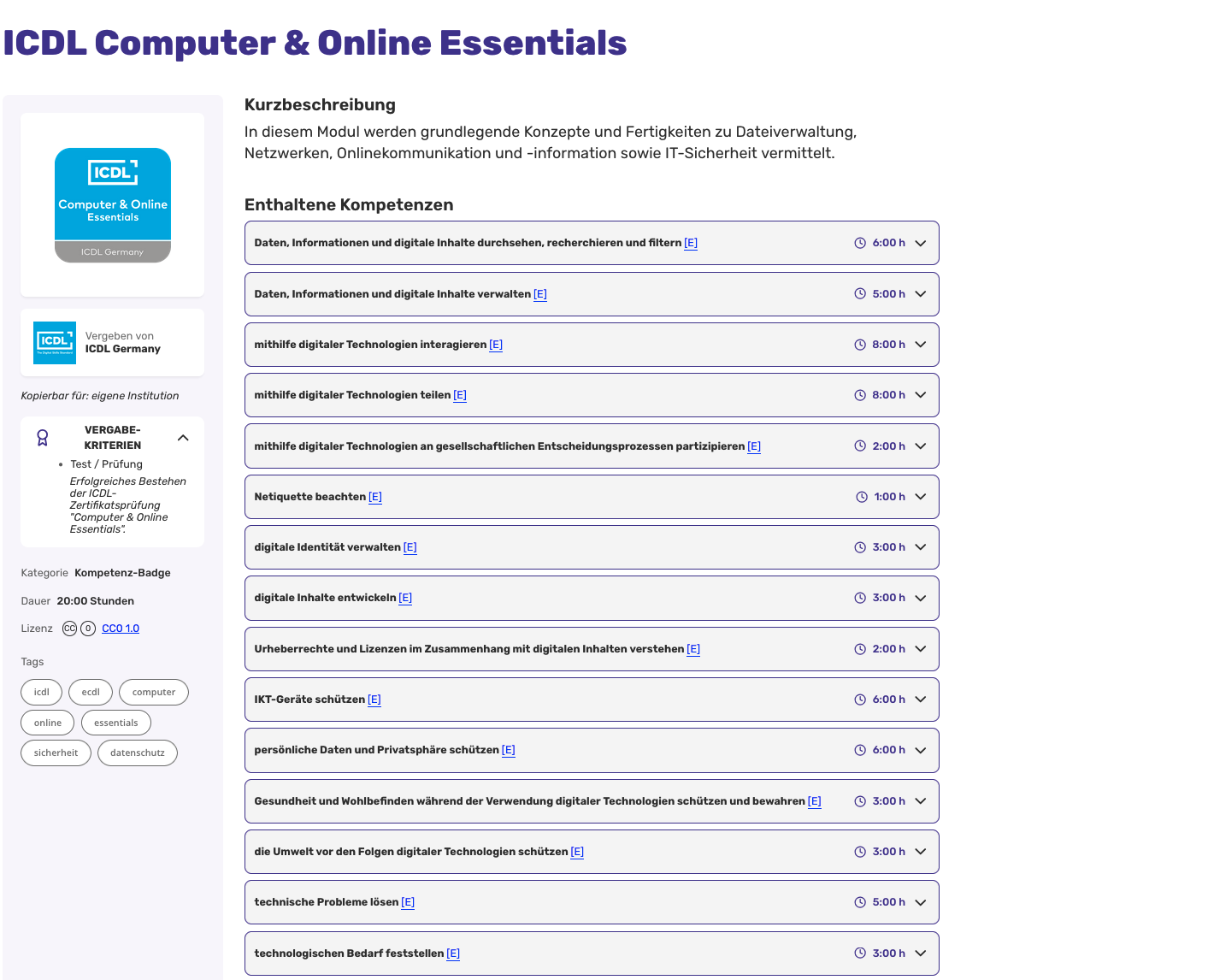
    When creating badges, the team combines standardization with its own domain expertise. The OEB AI assistant serves as a starting point by suggesting suitable ESCO competencies for each learning unit. These suggestions are then refined thematically or supplemented via the search function. The visual design of the badges is created by external graphic designers. In some cases, suitable competencies cannot be found in ESCO—for example, for certifications that DLGI develops for external partners. In those situations, the team defines its own competency descriptions directly within OEB to accurately reflect the specific requirements.
    At first, it felt unfamiliar to DLGI that OEB represents competency acquisition in terms of time. Since DLGI does not deliver courses itself but provides learning materials and administers exams, specifying hours initially seemed difficult to assess. On closer examination, however, it became clear that ICDL already provides partners with guideline estimates for the duration of each module. These can be meaningfully broken down to the level of individual competencies, creating a consistent point of reference. Today, the team clearly sees the added value: time-based information makes badges more precise and offers helpful transparency for both learners and partner institutions.
    Looking ahead, DLGI would welcome even more flexibility when creating badges—for example, the ability to organize selected competencies by category using drag-and-drop directly within the badge editor.

    Caption: ICDL badge with ESCO competencies.

    Insights from practice
    Digitally verifiable credentials make it much easier for learners to present their qualifications in professional contexts. They combine established standards with modern verification and are available exactly where they are needed. By connecting directly to the OEB API, DLGI has made the badge issuance process so efficient that no manual steps are required anymore — everything runs automatically, securely, and reliably in the background. The result is a system that does more than simply confirm exam results: it makes competence development visible while delivering a smooth and consistent user experience. The OEB API is particularly well suited for organizations that issue large volumes of badges or want to integrate certification seamlessly into existing platforms. In the meantime, badge creation and editing can also be handled via the API directly from an organization’s own system, and learners’ badge backpacks and competence profiles can be displayed within the same environment.
    DLGI has also observed that partner organizations and customers quickly recognize the added value. According to Stroh, many respond very positively to the option of having badges created for their learning units. DLGI therefore offers this proactively as an extended service that further strengthens its certifications.

    The future of digital certification
    For DLGI, one thing is clear: badges are a central building block for the future of certification. They connect formal credentials with modern, competence-oriented documentation and give learners new ways to make their skills visible — far beyond traditional paper or PDF certificates. At the same time, the integration via the OEB API demonstrates how easily digital badge issuance can be embedded into existing systems. Oliver Stroh looks ahead with confidence: “We’re excited to see badges gaining wider adoption, to the point where learners naturally expect to receive a badge when they complete a qualification.” Until then, DLGI continues to lead the way — convinced that digital credentials will play a decisive role in shaping modern qualification pathways.

    🔗 OEB-Profil of ICDL

    🔗 Technical Documentation Introduction

    🔗 Detailed Endpoint-Documentation

    🔗 API-INFO-PDF

    Curious?
    Give it a try!
    Register for free and create your first badge in just a few minutes.
    *Open Educational Resources are free learning and teaching materials that are published under an open license and thus made available for reuse by anyone interested.
    **OEB is based on a standardized framework, the ESCO competence standard. ESCO is the EU’s skills taxonomy and includes 14,000 skills in 28 languages. This ensures that all our badges speak the same language, remain comparable, and integrate seamlessly — no matter where they were earned.
    *** ESD is the abbreviation for Education for Sustainable Development. It refers to education that enables people to think and act in a sustainable manner. It enables each individual to understand the impact of their own actions on the world.

  • UfU: Making Climate Education Visible with Badges

    UfU: Making Climate Education Visible with Badges

    At the Independent Institute for Environmental Issues (UfU), everything revolves around future skills — and how to teach them effectively. In the NaKlima! training program, teachers discover creative ways to integrate nature-based climate protection into their lessons, for example through the digital learning journeys on klimacampus.org. To make the resulting competencies visible, UfU uses digital certificates via Open Educational Badges (OEB).
    “We found the idea exciting — not just issuing a plain certificate, but using OEB to align with the European Skills, Competences, Qualifications and Occupations framework, ESCO*,” explains Swenja Rosenwinkel, project lead at UfU. “It’s modern and a great way to build on existing standards.”
    ESCO makes skills comparable and recognizable across Europe — an important step toward a transparent, future-oriented approach to documenting education.

    Teaching climate protection and making skills visible

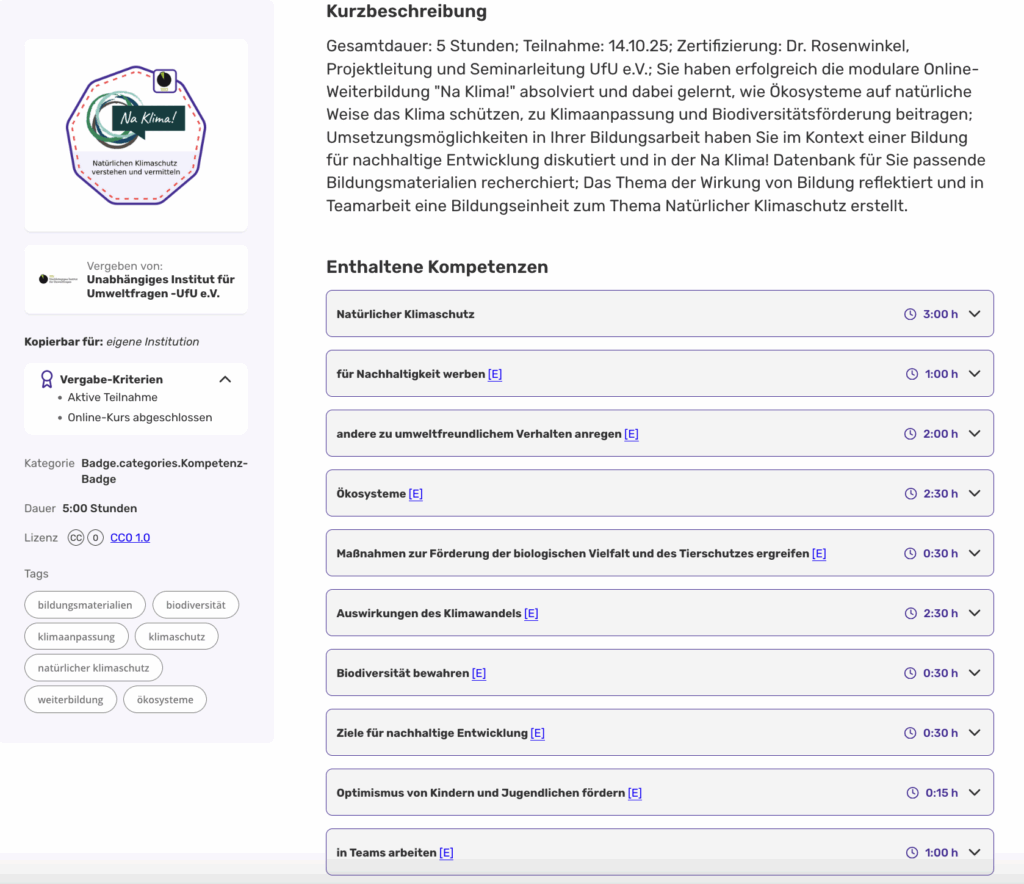
    NaKlima! is a modular training program with several components. Teachers don’t just gain subject knowledge; they also design their own lesson plans around nature-based climate protection. After completing the course, they receive a digital badge via OEB — a visible mark of their engagement and acquired skills.
    “We also want to show teachers that these digital credentials exist,” Swenja says. “Many have never heard of badges, but immediately see the potential for their students, especially for career orientation.”
    She’s referring to OEB’s learner functions: participants can collect badges in a personal backpack, get a visual overview of their skill profiles, and share their badges — for instance on social media or in job applications.
    Educational institutions also benefit from OEB’s features: badge records make it possible to track which competencies students have strengthened and which professional trainings teachers have completed. This creates a valuable foundation for developing staff qualifications in a targeted way. In the future, a dashboard view will make this even clearer.

    Modular learning, digital recognition

    UfU uses competence-based badges awarded at the end of the training program. While each of the three modules could theoretically be recognized separately, the team decided to issue a badge only for completing the full program.
    “If participants receive a certificate after just one module, their motivation to continue sometimes drops,” Swenja notes. “But a micro-degree can be a nice incentive — for example, if someone has to take a break, it works like a little ‘keep going!’ signal.”
    Badges are issued either directly by email or via a learner request using a QR code — depending on what works best organizationally. The flexibility of the OEB platform is a clear advantage for the team.

    From manual work to AI-assisted routine

    To create badges, UfU uses the AI assistant built into OEB, which links learning content with relevant competencies from the ESCO standard. “At first, it didn’t go completely smoothly,” Swenja recalls. “The AI sometimes made suggestions that didn’t fit our content, so there was a lot of manual work. If you’ve never worked with ESCO, you first have to find your bearings. But the OEB team supported us throughout.”
    With growing experience, the process became more efficient. The AI tool’s keyword search also proved useful for finding better-matched competencies. “And being able to copy and adapt existing badges saves an enormous amount of time,” she adds. “It’s also handy to see at a glance who has already received a certificate.”

    Wishes and further development

    For the future, Swenja hopes for even more customization options — for example, adding event dates or adjusting the layout of the PDF certificates that are generated alongside the badges and sent to participants. It’s also important that these digital credentials are understandable even outside the platform:
    “Many people still want a traditional certificate, because they’re not familiar with digital badges yet. It helps when it’s immediately clear what a badge represents.”
    The OEB team is already responding: the current redesign of the PDF certificates clarifies the link between digital and analog recognition. A PDF editor is also planned, allowing institutions to upload custom backgrounds in their own design. Soon, event dates can also be added directly during badge issuance. The AI assistant continues to be improved as well.

    Digital recognition with a future

    For UfU, OEB has proven to be a practical, professional, and time-efficient tool. “The badges look good and feel official — not like something you made yourself,” Swenja says. She believes “it’s a powerful idea to make learning visible and comparable across Europe. If schools and employers start recognizing badges, this could grow into something really big.”

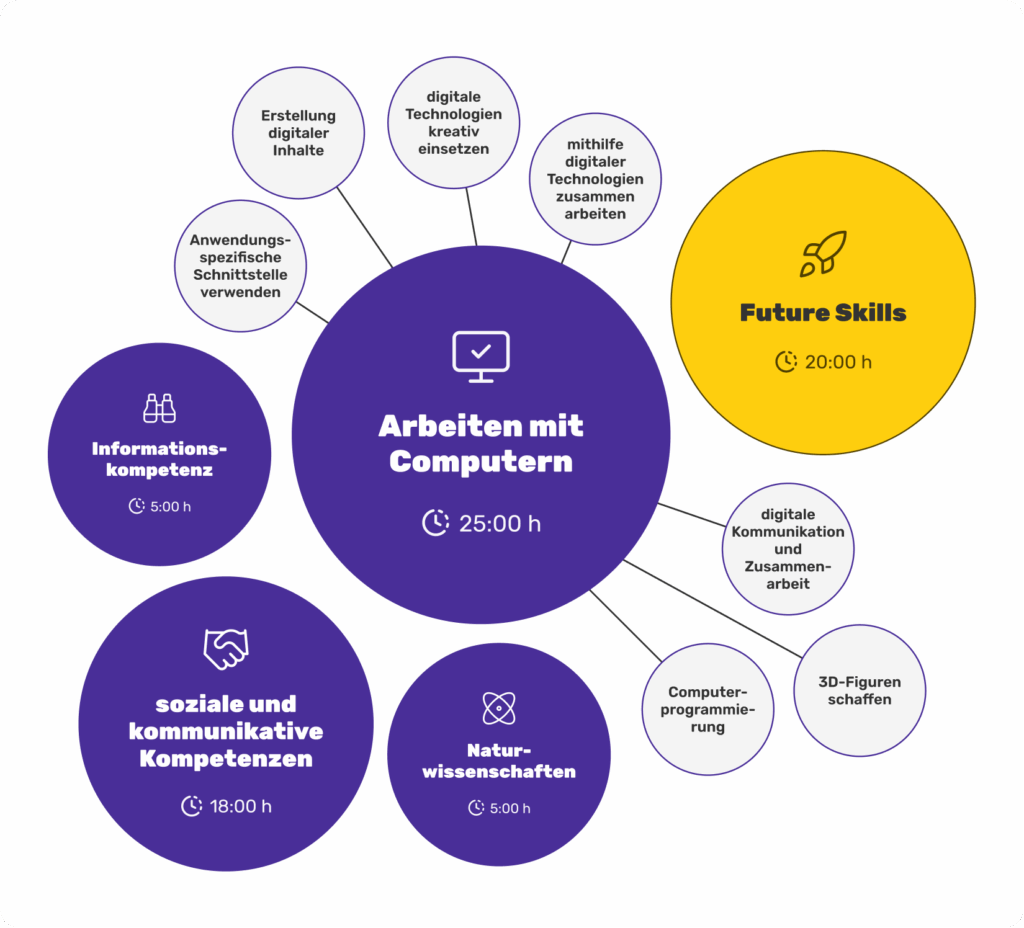
    Caption: Visualization of a competence profile (left) / UfU badge with ESCO competencies (right).

    🔗 OEB profile of UfU

    Curious?
    With OEB, you can easily create digital certificates, make competencies visible, and document learning progress — from schools and extracurricular programs to adult education.

    * OEB is based on a standardized framework — the ESCO competence standard. ESCO is the European Union’s skills taxonomy and includes 14,000 skills in 28 languages. This ensures that all our badges “speak the same language,” making them comparable and interoperable, no matter where they were earned.

  • UfU: Making Climate Education Visible with Badges

    UfU: Making Climate Education Visible with Badges

    At the Independent Institute for Environmental Issues (UfU), everything revolves around future skills — and how to teach them effectively. In the NaKlima! training program, teachers discover creative ways to integrate nature-based climate protection into their lessons, for example through the digital learning journeys on klimacampus.org. To make the resulting competencies visible, UfU uses digital certificates via Open Educational Badges (OEB).
    “We found the idea exciting — not just issuing a plain certificate, but using OEB to align with the European Skills, Competences, Qualifications and Occupations framework, ESCO*,” explains Swenja Rosenwinkel, project lead at UfU. “It’s modern and a great way to build on existing standards.”
    ESCO makes skills comparable and recognizable across Europe — an important step toward a transparent, future-oriented approach to documenting education.

    Teaching climate protection and making skills visible

    NaKlima! is a modular training program with several components. Teachers don’t just gain subject knowledge; they also design their own lesson plans around nature-based climate protection. After completing the course, they receive a digital badge via OEB — a visible mark of their engagement and acquired skills.
    “We also want to show teachers that these digital credentials exist,” Swenja says. “Many have never heard of badges, but immediately see the potential for their students, especially for career orientation.”
    She’s referring to OEB’s learner functions: participants can collect badges in a personal backpack, get a visual overview of their skill profiles, and share their badges — for instance on social media or in job applications.
    Educational institutions also benefit from OEB’s features: badge records make it possible to track which competencies students have strengthened and which professional trainings teachers have completed. This creates a valuable foundation for developing staff qualifications in a targeted way. In the future, a dashboard view will make this even clearer.

    Modular learning, digital recognition

    UfU uses competence-based badges awarded at the end of the training program. While each of the three modules could theoretically be recognized separately, the team decided to issue a badge only for completing the full program.
    “If participants receive a certificate after just one module, their motivation to continue sometimes drops,” Swenja notes. “But a micro-degree can be a nice incentive — for example, if someone has to take a break, it works like a little ‘keep going!’ signal.”
    Badges are issued either directly by email or via a learner request using a QR code — depending on what works best organizationally. The flexibility of the OEB platform is a clear advantage for the team.

    From manual work to AI-assisted routine

    To create badges, UfU uses the AI assistant built into OEB, which links learning content with relevant competencies from the ESCO standard. “At first, it didn’t go completely smoothly,” Swenja recalls. “The AI sometimes made suggestions that didn’t fit our content, so there was a lot of manual work. If you’ve never worked with ESCO, you first have to find your bearings. But the OEB team supported us throughout.”
    With growing experience, the process became more efficient. The AI tool’s keyword search also proved useful for finding better-matched competencies. “And being able to copy and adapt existing badges saves an enormous amount of time,” she adds. “It’s also handy to see at a glance who has already received a certificate.”

    Wishes and further development

    For the future, Swenja hopes for even more customization options — for example, adding event dates or adjusting the layout of the PDF certificates that are generated alongside the badges and sent to participants. It’s also important that these digital credentials are understandable even outside the platform:
    “Many people still want a traditional certificate, because they’re not familiar with digital badges yet. It helps when it’s immediately clear what a badge represents.”
    The OEB team is already responding: the current redesign of the PDF certificates clarifies the link between digital and analog recognition. A PDF editor is also planned, allowing institutions to upload custom backgrounds in their own design. Soon, event dates can also be added directly during badge issuance. The AI assistant continues to be improved as well.

    Digital recognition with a future

    For UfU, OEB has proven to be a practical, professional, and time-efficient tool. “The badges look good and feel official — not like something you made yourself,” Swenja says. She believes “it’s a powerful idea to make learning visible and comparable across Europe. If schools and employers start recognizing badges, this could grow into something really big.”

    🔗 OEB profile of UfU

    Curious?
    With OEB, you can easily create digital certificates, make competencies visible, and document learning progress — from schools and extracurricular programs to adult education.

    * OEB is based on a standardized framework — the ESCO competence standard. ESCO is the European Union’s skills taxonomy and includes 14,000 skills in 28 languages. This ensures that all our badges “speak the same language,” making them comparable and interoperable, no matter where they were earned.

  • How young people perceive open educational badges

    How young people perceive open educational badges

    How can digital credentials such as Open Educational Badges (OEB) be designed so that they are truly relevant to young people?

    This question is explored in the new interim report on accompanying research in the MINT.OBadges project.

    In over 90 pages, Prof. Dr. Ilona Buchem (Berlin University of Applied Sciences) provides insightful insights from focus groups, interviews, and surveys with school and university students. The results show that open badges have great potential—provided they are credible, compatible, and individually meaningful.

    What is particularly exciting is that the study combines findings from self-determination theory with the HEXAD typology of player types. This makes it clear which design elements really work for different users – from “achievers” to “free spirits.”

    👉 The interim report is now available for download:

  • Making future skills visible – with open educational badges and ESCO

    Making future skills visible – with open educational badges and ESCO

    In a world that is changing ever more rapidly, future skills—such as critical thinking, problem solving, and digital literacy—are becoming increasingly important. But how can they be measured and made visible? This is where the new white paper “Open Educational Badges for Future Skills” comes in.

    Why future skills are crucial
    The demands of the working world are changing rapidly. Education must be more flexible and accessible throughout life so that people can continue to develop.

    How Open Educational Badges help
    Digital badges are an innovative way to present learned skills in a transparent and recognized manner, regardless of formal qualifications. They enable learners to document and showcase their skills in a flexible way.

    The key: ESCO as a competency standard
    For badges to be used effectively, they must be clearly defined. The white paper shows how ESCO (European Skills, Competences, Qualifications, and Occupations) is used as a European standard for describing future skills to enable precise and comparable representation.

    The white paper by Prof. Dr. Ulf-Daniel Ehlers provides exciting insights into:
    ✔ The NextSkills competence framework, which defines 17 essential future skills
    ✔ The connection between open badges and standardized competence descriptions
    ✔ The role of ESCO and how it contributes to better recognition of skills.

    Why this is important The combination of future skills, open badges, and ESCO creates a forward-looking opportunity to make competencies visible—for learners, companies, and educational institutions. This effectively promotes lifelong learning and provides targeted support for professional development.

  • Desktop Research: Overview of Open Badge Projects

    Desktop Research: Overview of Open Badge Projects

    In this comprehensive summary, Prof. Dr. Ilona Buchem has compiled an overview of international projects in the field of open badges. The document provides an overview of the development of badges in higher education, continuing education, and in municipal and international contexts. Scientific research papers are attached and integrated. Success factors are evaluated and highlighted.